- Review skills advise only; authoring skills write one artifact.
- No skill runs `git add`, commit, push or tag.
- Outputs trace to Keep a Changelog, INVEST, Scrum, SAFe and OpenSSF OSPS.
Problem
Recurring lifecycle work, such as reviewing a diff, writing a changelog, filing a well-formed ticket, gets done ad hoc, differently each time and differently by each person. Automating it with an agent introduces a sharper problem: an agent that can edit and commit your code is an agent that can quietly ship something you did not review.
Approach
Split the work into two classes with deliberately opposite stances toward your repository, and give them one shared rule: the human decides what gets committed. Review skills advise and leave no files behind. Authoring skills write exactly one artifact and then propose the commit. They never run git add, commit, push or tag. Item formats are grounded in external standards rather than house style, so the output is recognizable to anyone: Keep a Changelog, INVEST, the Scrum Guide, SAFe, and the OpenSSF OSPS Baseline cited by control ID.
Solution
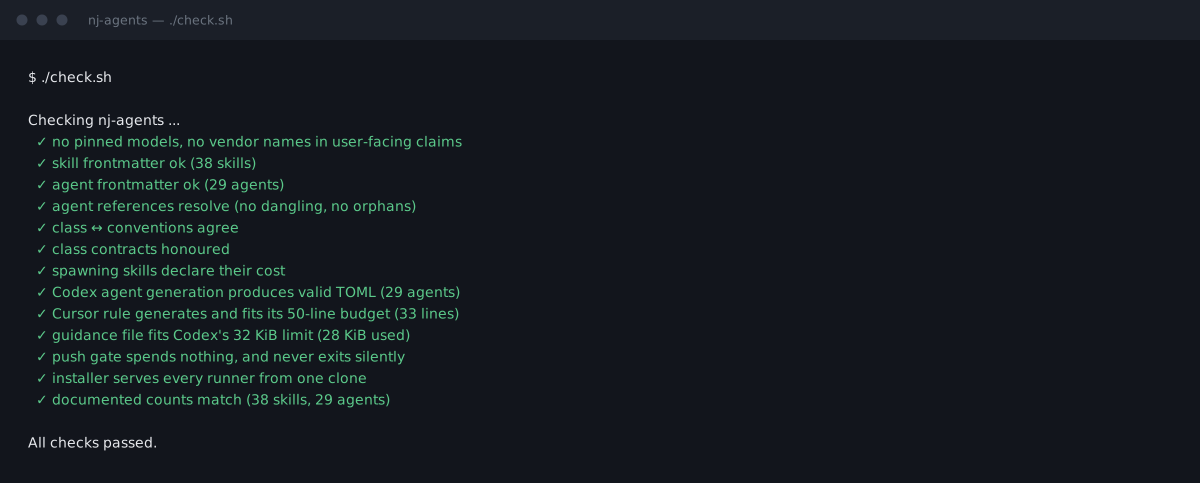
Skills and agents installed by symlink into any project or globally, spanning six classes. The pre-push umbrella gates on a secret scan first and then parallelizes five review dimensions, and it requires a real scanner (gitleaks, trufflehog or detect-secrets), with no heuristic-only fallback, because a heuristic that misses a key is worse than an honest block. The authoring suite covers changelogs, architecture diagrams, documentation sites, auto-redacted screenshots and technical blog posts, where the fact-checker blocks any claim it cannot verify against the repository. Structure is validated by globbing rather than a registry, so there is no registration step to forget.
Impact
nj-agents turns ad hoc lifecycle work into repeatable workflows a team can run the same way across repositories, while keeping the final commit decision with a person. The suite gives review, documentation, PM and release tasks a shared operating model instead of a fresh prompt each time.