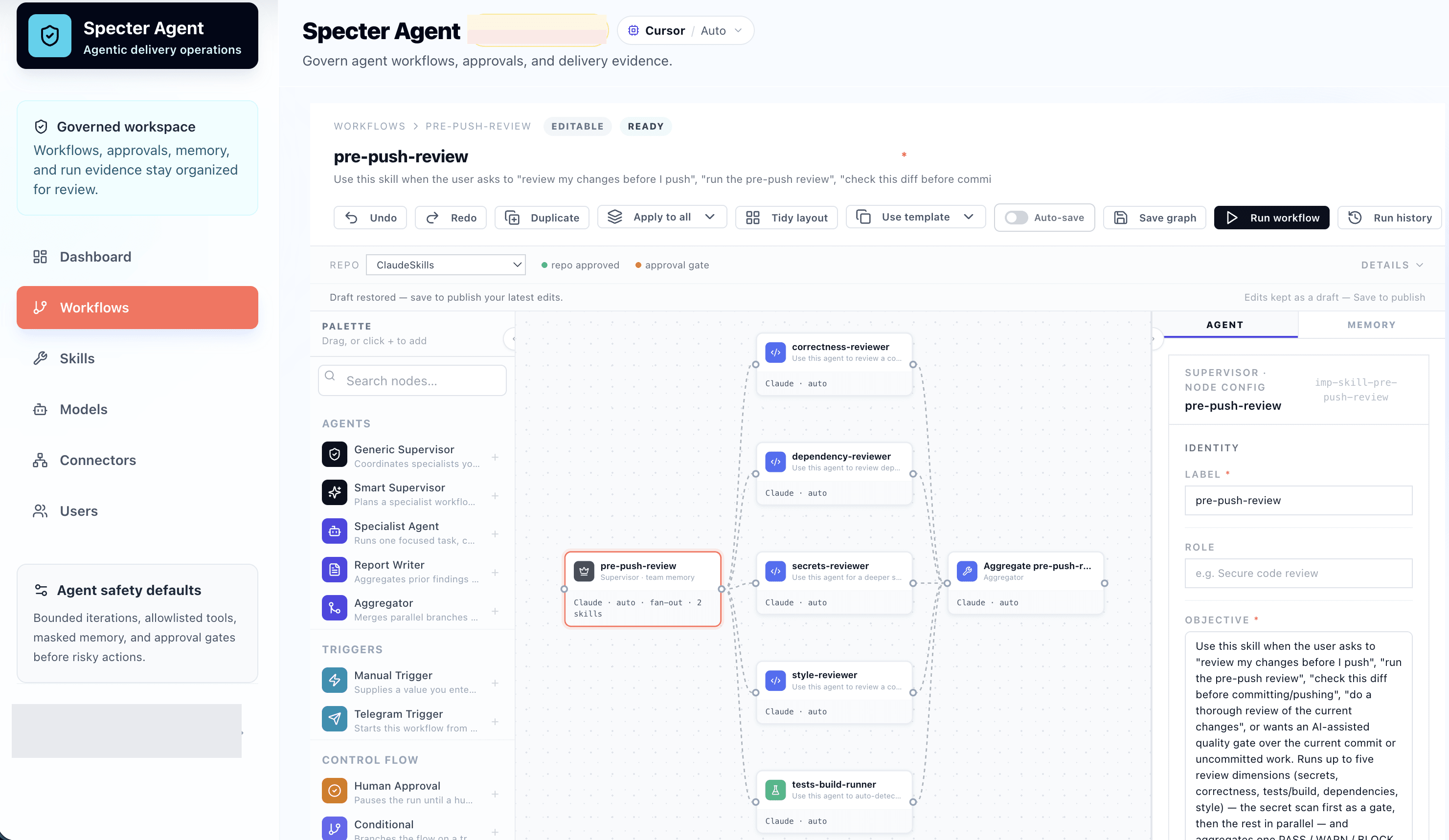
- Uses local agent CLIs and existing subscriptions instead of token-billed API calls.
- Coordinates multiple assistants across one piece of work.
- Isolated git worktree per agent run.
- Warden status for filesystem, credential, read and network boundaries.
Problem
The most capable coding assistants are often already paid for as user subscriptions, but agentic software workflows usually push teams toward token-billed API usage. That makes experimentation expensive: you pay for the assistant in your terminal, then pay again when you want the same kind of work coordinated as a workflow. Once that workflow can touch a checkout, credentials and a shell, it also needs real boundaries rather than a hopeful prompt.
Approach
Keep the economics and credentials with the developer's existing tools. Specter shells out to locally authenticated agent CLIs and coordinates them as a workflow, while moving the safety boundary out of the prompt and into the runtime. Each run gets a separate git worktree, writes are confined to that workspace, network access routes through an allowlist, and approval gates stop actions that need a human decision.
Solution
A Go service and React workspace coordinate supervisors, specialist agents and approvals from one browser UI. The assistants remain the local tools the user has already installed and signed into; Specter provides the workflow layer around them. The Warden status view exposes the active guardrails layer by layer, including filesystem, credentials, reads and network policy, and write work is separated from the user's branch before it is presented for review.
Impact
Specter makes agentic coding workflows usable without making metered API spend the default cost model. Developers can coordinate multiple subscribed assistants on real work while keeping credentials local, isolating each run, and reviewing the result before it touches their branch.